
ARTICLE AD BOX
Prime Minister Mark Carney’s first budget is being billed by the government as a “generational” investment in Canadian infrastructure and productivity in a time of “rupture” in global trade and the international order.

The question now is whether Carney’s decision to simultaneously run a sizeable deficit while slashing public service jobs will find support among opposition parties, or send Canadians to a second general election this year.
“The speed, scope and scale of change that we’re seeing in Canada and around the world is quite unprecedented,” said Finance Minister François-Philippe Champagne in an Ottawa news conference Tuesday.
“This is not a transformation. This is a generational shift, and we need to meet this moment with generational investment. To weather the storm of uncertainty, we will not lower our sails … We will do what previous generations have done before us. We will raise them to catch the winds of economic change.”
Story continues below advertisement
3:43
Carney’s fiscal plan to grow the Canadian economy

The government’s 2025 budget, unveiled by Champagne Tuesday, sets out an agenda of $141.4 billion in new spending offset by $51.7 billion in projected savings over the next five years, with the deficit projected at $78.3 billion this year.
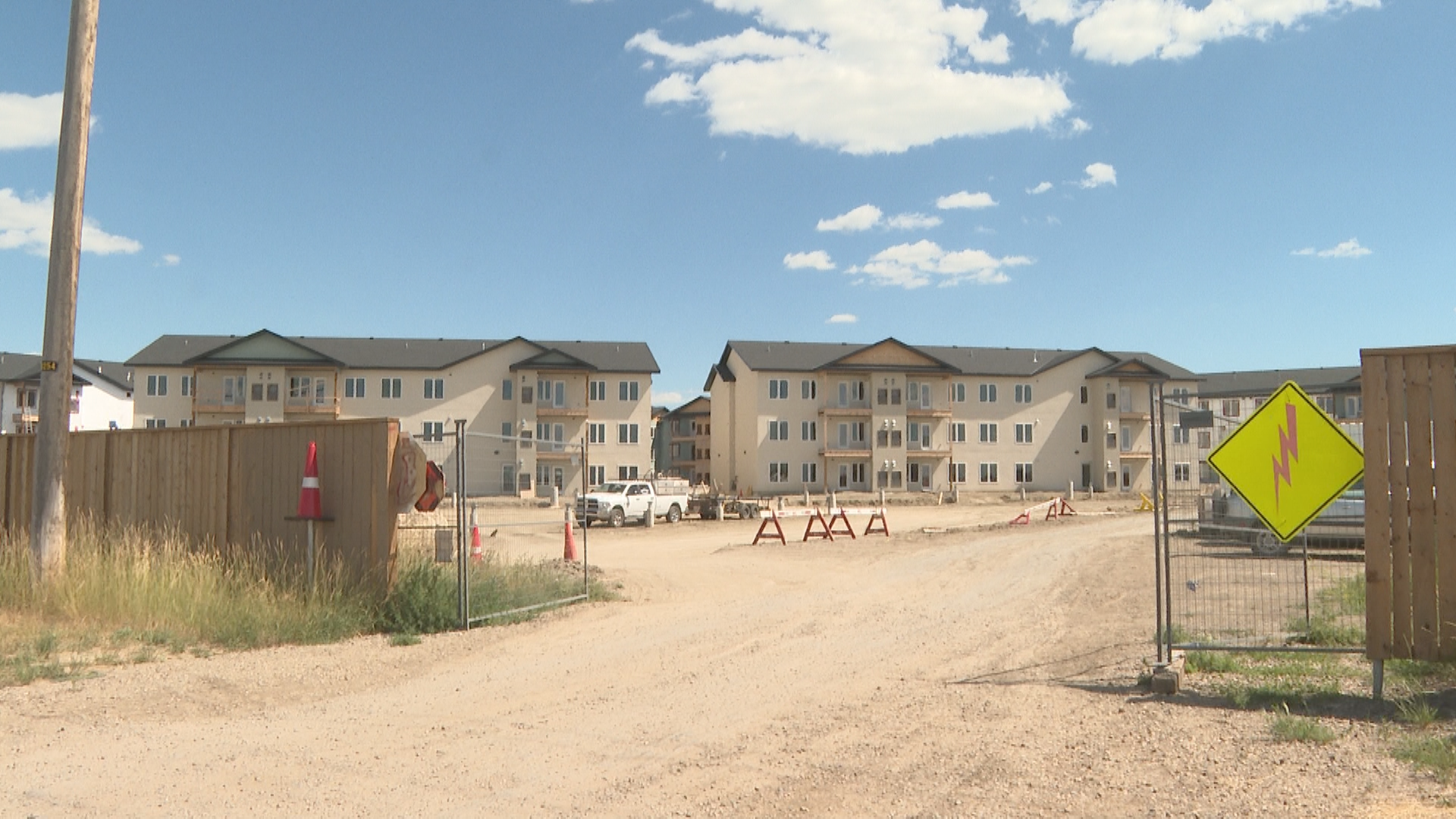
The budget touts $115 billion in infrastructure spending over five years, $30 billion more in defence and security spending and $25 billion for federal housing initiatives over that same period.
It also promises to invest $110 billion over five years in “productivity and competitiveness” initiatives – measures the government hopes will help their new target of “catalyzing” $500 billion in private sector investment by 2030.
The budget document suggests Canada is at a “crossroads” – and that the “global shocks” the country has endured in recent months “demand more than short-term fixes; they call for a bold down payment on the prosperity of the next generation.”
Story continues below advertisement
That “down payment” works out to a $78.3 billion deficit this fiscal year, up from the $42.2 billion deficit forecast in the previous Liberal government’s last economic update back in December 2024.

Get breaking National news
For news impacting Canada and around the world, sign up for breaking news alerts delivered directly to you when they happen.
The Carney government’s budget decisions are taking place against the backdrop of significant geopolitical uncertainty, as well as a weak economic outlook.
Kevin Page, the president of the Institute for Fiscal Studies and Democracy and a former parliamentary budget officer, said that puts the Liberal government in a tough spot.
“(The government) has to present the fact that the economy is weak, and there’s some systematic reasons for this weakness. And we also have this rupturing of just a changing world … we’re dealing with wars in Europe, in the Middle East,” Page told Global News.
“On the other hand, (the government) has to build confidence. It has to tell people that, you know, we can do this. We can build, you know, we built infrastructure before, we can do this again. And we could do it in a very timely way.”
2:01
Young Canadians hoping for support in Carney’s federal budget

The budget highlighted significant headwinds for the Canadian economy, with unemployment rising from 6.6 per cent in February to 7.1 per cent in September – with industries exposed to U.S. trade strife hit particularly hard.
Story continues below advertisement
The government is now projecting real GDP to grow just above one per cent in 2025 and 2026 – significantly lower than the two per cent forecast in the previous government’s Fall Economic Statement in 2024.
“The hope is you’ll start to see, two years out … you start to see two per cent growth again,” Page said.
“But the (Bank of Canada), the PBO and Minister Champagne are all showing one per cent growth this year and next year, the kind of growth where you have weak labour markets for an extended period of time. And that’s not good.”
Trending Now
Will opposition parties support it?
Pierre Poilievre’s Conservative Party was demanding a deficit no larger than $42 billion – and will be unlikely to back the budget even while the Liberals explore removing the cap on emissions from the oil and gas sector.
Story continues below advertisement
At the same time, flirting with removing the oil and gas emissions cap – something the government says would require effective carbon markets, methane regulations and the deployment of new carbon capture and storage technologies – means the Liberals may face an uphill battle to get support from the Bloc Québecois or the remaining NDP MPs.
“When the conditions are met, we won’t need the cap anymore,” Champagne told reporters.
1:59
Canadians split before Carney’s 1st budget, new poll shows doubt

The seven NDP MPs would be enough to prop up the government’s agenda. But the New Democrats are in the midst of a leadership campaign, making the political price of voting to support Carney’s agenda even steeper.
That price gets prohibitive with the budget’s plan for significant cuts to the federal public service in an attempt to rein in Ottawa’s operating budget.
Story continues below advertisement
Carney’s budget books $60 billion in cuts to government spending over five years, ramping up to $13 billion saved annually by 2028-29. That includes the elimination of 40,000 positions – roughly 10 per cent of the public service – over the next three years.
The government argued that the federal public service has grown at an unsustainable rate – up to 368,000 workers in 2024, a roughly 40 per cent increase since 2015.
The Liberal budget cuts will include “restructuring” public service operations and consolidating some services within government, as well as “rightsizing programs to realize efficiencies.” That “rightsizing” will mean relying on attrition as well as job cuts to reduce the size of the bureaucracy.
The budget notes that the Liberals’ “Comprehensive Expenditure Review” is roughly comparable to former Prime Minister Stephen Harper’s Deficit Reduction Action Plan in 2012 – an exercise that led to years of strife between the Conservatives and public service unions.
The combination of sizable deficits with significant cuts to the public service makes the Carney government’s maiden budget a difficult political sales job.
And if the Liberals can’t find a buyer in the House of Commons, they’ll be forced to market it directly to voters in a general election.
© 2025 Global News, a division of Corus Entertainment Inc.





 English (US)